





Under the General Data Protection Regulation (GDPR) enforced by the European Union, we are committed to safeguarding your personal data and providing you with control over its use.
Solutions
Aug. 18, 2026
GIGABYTE W775-V10-L01
W775-V10-L01
GIGABYTE W775-V10-L01
A department-scale AI node that brings agentic workflows into daily use.
Up to 748 GB
Coherent memory
Up to 20 PFLOPS FP4
AI performance
Up to 7.1 TB/s
HBM3E Memory bandwidth
Up to 9,000 tok/s**
Peak output throughput
Proven to work
From waiting on AI to working with it
400 people asking at once, and the first word still lands inside two seconds
One person getting a quick response is expected. What really matters is whether the system holds up under the workloads of the whole department.

Concurrent requests
400 simultaneous requests with no one left waiting in the queue

Time to first token*
Under heavy workloads the response time is still under two seconds

Peak aggregate throughput
Close to nine thousand tokens per second, sustained

Core temperature at full load
When the GPU is running at 100 percent (%) there is still thermal headroom to spare
* Time to first token is how long you wait between sending a question and seeing the first word of the answer.
** Test Condition Footnote: Model nvidia/nemotron-3-super-120b-a12b. 400 concurrent requests, up to 4,700 output tokens per request, 180 second run. Measured live on GIGABYTE AI Platform. Actual capacity and response times vary with model, prompt length and workload.
Fast to deploy
Out of the box, into work
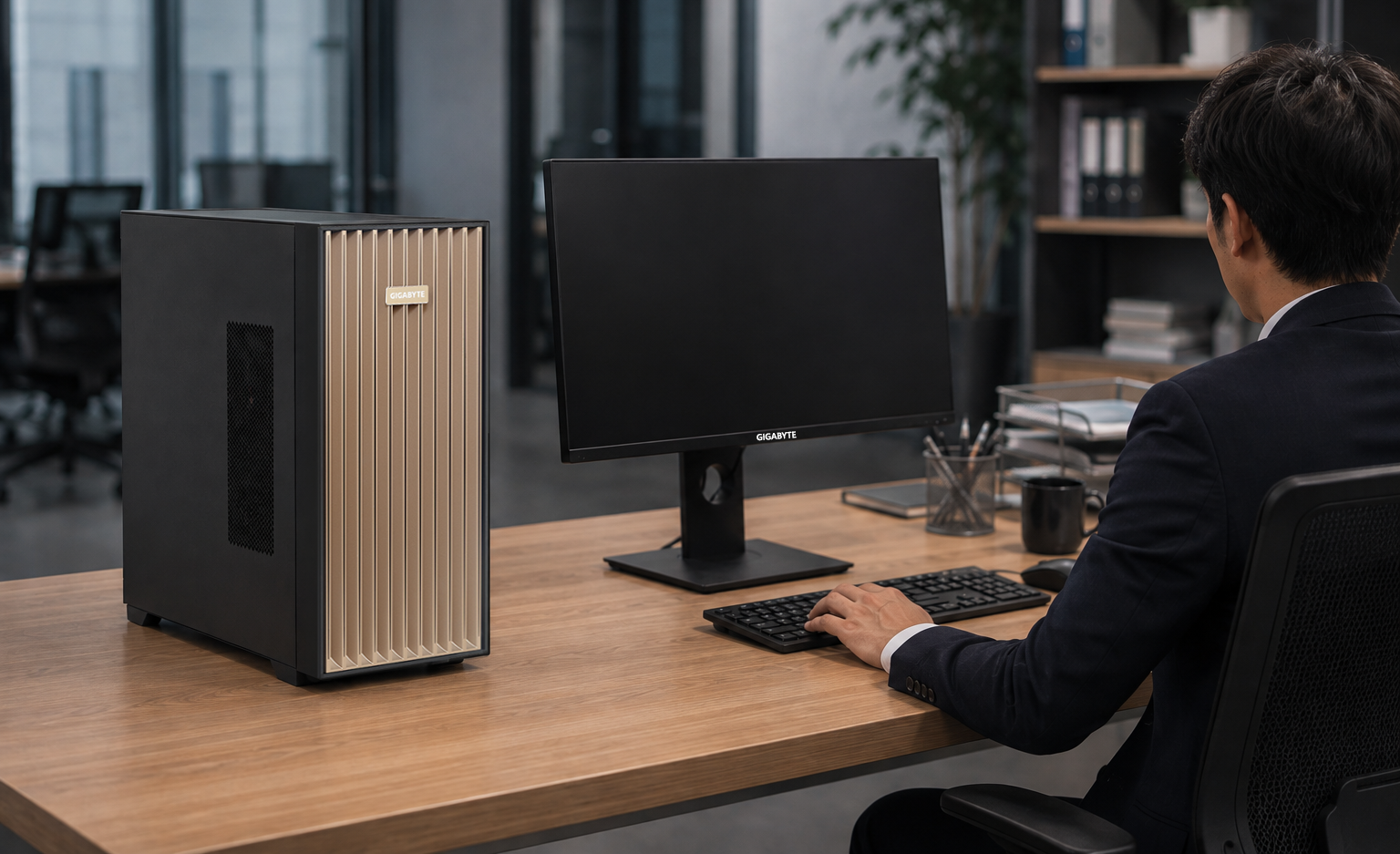
__26I04V2OHF.png) Runs on a standard wall outlet: No dedicated PDU, no electrical work
Runs on a standard wall outlet: No dedicated PDU, no electrical work- Tower chassis, fits beside a desk: 732 x 400 x 775 mm
- Quiet, even at full load: Closed-loop liquid cooling keeps noise within ambient office levels
- Thermal headroom under sustained load: GPU at 100 percent, core temperature around 65°C, draw of 1,000 to 1,200 W against a 1,300 W design figure
- Leak detection built in: A sealed loop with leak detection sensors
Workstation systems require no extra infrastructure for operation.
How long before the team is actually using it?
From hardware to a ready-to-use departmental service
Compute is only one piece. What really shortens the path is having model serving, the agent environment, and monitoring already in place.
The hardware supplies the compute. The environment is what gets an application into use.
AI applications
OpenClaw, NVIDIA AI-Q, and applications you build yourself
Model serving
Local LLM serving, API access, fine-tuned models
Operating environment
Compute, runtime, live status monitoring
Local control
Your models, your data, your call
The cloud gives you AI. Your own machine gives you control.
A
Reduce cloud reliance
Critical processes stay local, not cloud-dependent.
B
Model versions
External model updates can shift output quality and behavior without notice
C
Cost and API policy
High frequency work needs a cost you can forecast
D
Data boundary
Internal documents, procedures and know-how are better kept inside a boundary you define
Ready to scale
One department, then the next
W775 is not the end goal. It is the most practical first step when scaling enterprise AI.
1
__26H19Pw5oR.png)
W775 AI workstation
One department, up and running, value demonstrated
2
__26H19hqfoS.png)
Multiple W775 / GPU servers
Cross-department work and heavier workloads
3
GIGAPOD / AI Factory
Enterprise scale, large models, mixed workloads
Contact Our Experts to Find the Right Solution
Contact UsOther
Solutions
May. 13, 2026
GIGABYTE Solutions for NVIDIA Rubin Platform
Solutions
Dec. 05, 2025
Intel Gaudi 3
Solutions
Nov. 01, 2025